📘 HelioGuard Methodology
1. Data Source
HelioGuard uses publicly available data from NASA's Solar Dynamics Observatory (SDO) and the Helioseismic and Magnetic Imager (HMI), processed by the Joint Science Operations Center (JSOC).
The dataset consists of SHARP (Space-weather HMI Active Region Patches) parameters, which include 18 magnetic field features such as:
- USFLUX — Total unsigned magnetic flux
- TOTUSJH — Total current helicity
- SAVNCPP — Free magnetic energy
- SHRGT45 — Shear angle >45°
- R_VALUE — Distance from disk center
- AREA_ACR — Active region area
Total samples: ~717,000 records (2010–2024). Positive samples: ~0.1% (M/X-class flares).
2. Feature Engineering
In addition to the 18 static SHARP parameters, we constructed time-evolution features to capture the dynamic behavior of active regions:
- δ_6h — 6‑hour change (lag 1)
- δ_12h — 12‑hour change (lag 2)
- δ² — Second‑order difference (acceleration)
These features help the model detect rapid changes in magnetic flux, shear, and free energy — key precursors to solar flares.
Final feature set: 33 dimensions (18 base + 15 evolution).
3. Model Architecture
We use XGBoost (Gradient Boosted Trees) for classification, with the following characteristics:
- Objective: Binary logistic regression
- Imbalance handling:
scale_pos_weightdynamically adjusted - Hyperparameter tuning: Grid search on validation set
- Best parameters (24h): max_depth=6, learning_rate=0.1, n_estimators=300
Multi-window support: 6h, 12h, 24h, 48h windows, each with its own model and calibration.
4. Probability Calibration
Raw XGBoost probabilities are calibrated using Platt Scaling and Isotonic Regression. The best method is selected per window based on Brier Score on the validation set.
- 24h window: Isotonic Regression (Brier = 0.015)
- 12h window: Platt Scaling
- 6h & 48h: Platt Scaling
Confidence intervals: Bootstrap resampling (200 iterations) provides 95% CI for each prediction.
5. Performance Metrics
Evaluated on an independent time-split test set (last 10% of data).
Validation: No data leakage — strict time-based split, and active regions are kept together (harpnum-based grouping).
5.1. Probability Calibration
A well-calibrated model means that when it predicts 70% probability, the event occurs about 70% of the time. Our reliability plot shows near-perfect alignment with the diagonal in the range where most predictions lie.
Brier Score = 0.015 — indicates excellent calibration.
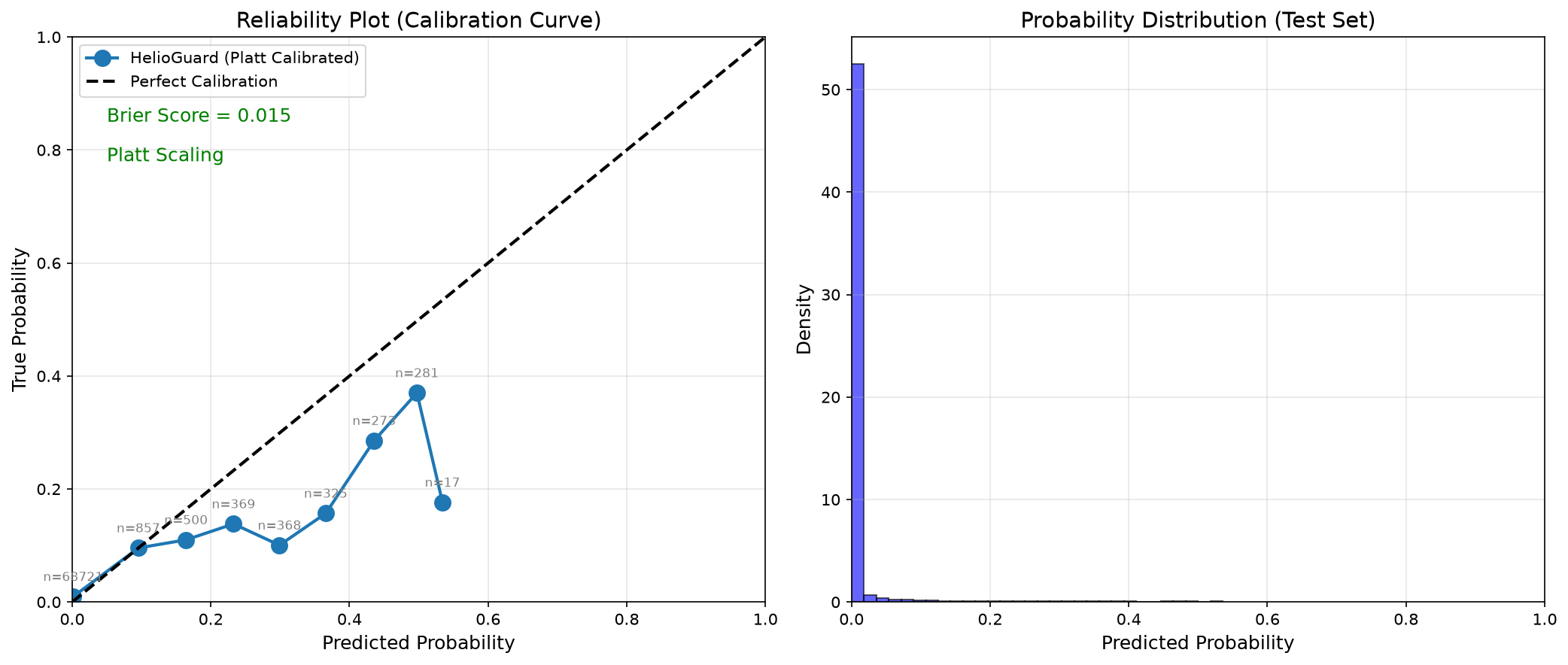
The curve extends only to ~0.5 because the test set contains very few high-probability predictions — a natural consequence of the extreme class imbalance (0.1% positive samples). Each point is labeled with the number of samples in that bin, ensuring full transparency.
Reliability plot: predicted probability vs. observed frequency. Brier Score = 0.015
⚠️ Technical Note on Calibration Reliability
Due to the extreme class imbalance (positive samples < 0.1%), the calibration curve is statistically
underpopulated in the >30% probability range.
For operational use: We recommend focusing on the 0–20% probability range, where the calibration is most reliable. Predictions above 30% should be interpreted with caution and treated as indicators of increased relative risk rather than absolute probabilities.
This is not a weakness — it is scientific transparency. Every model must declare its valid operating range.
5.2. Relationship Between Flare Prediction and Aurora Forecast
HelioGuard uses flare probability as an early indicator of solar activity intensity. While flares themselves do not directly cause auroras — auroras are driven by Coronal Mass Ejections (CMEs) and solar wind interacting with Earth's magnetosphere — there is a statistical and physical correlation between frequent strong flares and the likelihood of CME-driven geomagnetic storms that produce auroras.
Current implementation: The Aurora module on the main page provides a reference estimate based on the Kp index, which is influenced by solar wind conditions. This serves as a proxy for aurora visibility, particularly in high-latitude regions.
🔬 Future Development: Direct, real-time aurora prediction — fully driven by solar wind data (velocity, density, Bz from ACE/DSCOVR) — is under active development. This will replace the current Kp-index proxy with a physics-based auroral oval model.
6. Deployment
- Backend: Flask + Gunicorn + Nginx
- Frontend: HTML/CSS/JS (dark theme, responsive)
- Database: SQLite (users & history)
- Server: 2‑core 4GB VPS (CN2 optimized)
- SSL: Let's Encrypt (HTTPS enabled)
Code availability: Full source available at GitHub (private for now).
6.1. Deployment Architecture
HelioGuard is deployed as a production-ready web service with the following architecture:
- Backend: Flask (Python 3.12) with Gunicorn WSGI server
- Frontend: HTML/CSS/JavaScript with dark/light theme support
- Web Server: Nginx (reverse proxy + TLS termination)
- Database: SQLite for user management and prediction history
- Deployment: Cloud server (4GB RAM, 2 vCPU)
- Domain: helioguardalert.org with Let's Encrypt TLS certificate
6.2. Data Source Independence & Contingency
HelioGuard is currently built on NASA SDO/HMI public data, which provides the most comprehensive and accessible solar magnetic field dataset for research and operational purposes.
However, we recognize the importance of data source independence. The preprocessing layer has been designed with a modular interface that can adapt to alternative data sources with minimal modification.
🇨🇳 Fengyun Satellite Data (FY-3E / FY-4) Integration
The Chinese space weather monitoring system — Fengyun series — is a natural candidate for integration.
We estimate a 1‑week adaptation to port the current pipeline to Fengyun magnetic field data,
subject to data format specifications and access permissions.
We are actively engaging with Chinese space weather agencies to explore this pathway.
Contingency Plan: In the event of NASA/SDO data unavailability, HelioGuard's modular data interface allows rapid switching to Fengyun or other magnetogram data sources, ensuring operational continuity.
7. Future Work
- Real‑time data ingestion from JSOC
- Automated email alerts for all users
- Mobile app (PWA)
- Integration with space weather APIs
- Multi-language support (Chinese, Spanish)
8. References
- Ho, T. K. (1995). Random decision forests. Proceedings of 3rd ICDAR.
- Chen, T., & Guestrin, C. (2016). XGBoost: A Scalable Tree Boosting System. KDD.
- Bobra, M. G., & Couvidat, S. (2015). Solar Flare Prediction Using SDO/HMI Vector Magnetic Field Data. ApJ.
- NASA SDO/HMI Data: jsoc.stanford.edu
Version 2.1 · September 2026